 Binance
Binance withdrawals - amount limits and security holds
Binance withdrawals depend on available funds, the account's remaining allowance and any security hold that applies to the transfer. A daily amount limit caps withdrawal value across the applicable window. A security hold can pause transfers after a password change or another security event, even with allowance remaining. Crypto transfers also face network-specific minimums and availability. Fiat withdrawals follow the selected payment method's limits. The account notice determines whether the next step involves adjusting the amount, waiting or completing verification.
Last updated
Reducing a withdrawal amount helps only when the selected funds remain available and no security hold blocks the transfer.
Smaller requests, waiting periods and verification
A smaller request helps only when it fits the applicable amount boundaries and no separate restriction blocks it. An amount-limit rejection concerns the requested value. A security suspension concerns permission to withdraw, while a network suspension concerns the selected route. The message beside the withdrawal request identifies which constraint needs attention. Several restrictions can apply together, so resolving an amount error does not establish that the destination or account is ready.
| Adjustment or recovery option | Condition that still applies |
|---|---|
| Reduce the requested amount | The remaining allowance, available balance and withdrawal minimum still apply. |
| Wait for the stated security suspension to end | The applicable timer must expire; separate verification restrictions may remain. |
| Choose another available network | Binance and the recipient must both support the asset on that network. |
| Submit an offered withdrawal appeal | The relevant verification or review must resolve the stated restriction. |
| The available option follows the restriction shown for the account, selected funds or network. | |
An account-wide suspension affects the withdrawal function. A lock on particular funds affects the restricted amount. A network outage affects that route. Those scopes determine whether another withdrawal option remains available.
Where can I see my withdrawal limit?
The Identification page shows your account's withdrawal limits, while the withdrawal form shows the constraints for the selected request. Limits vary with the applicable verification requirements and jurisdiction. A figure quoted for another account or payment method does not establish your allowance. The displayed account status also matters when verification information needs updating or a restriction requires review.
Daily allowance and remaining capacity
The daily allowance caps cumulative withdrawal value during the applicable window. Previous withdrawals consume capacity, so the account limit and its remaining portion describe different amounts. Read the unit beside the limit and use the remaining capacity for the intended request. A balance expressed in units of an asset and an allowance expressed as equivalent value cannot be compared as identical quantities. The applicable window governs when capacity returns; a password-change timer follows a separate security rule.
Per-request boundaries
The selected asset and network can impose minimum and maximum amounts for an individual request. Those boundaries apply alongside the account allowance. Splitting a transfer changes request sizes without creating extra daily capacity, and every resulting request must still qualify.
Funds available for withdrawal
The withdrawable balance can be lower than the combined holdings shown across the exchange's different account sections. Funds that remain committed to an open spot limit order are not freely available for withdrawal. An Earn subscription may require redemption before its assets return to an available balance. Redemption has its own product conditions, so requesting it does not prove that the funds have returned. Spot and Funding balances also serve different account functions. The available amount for the selected withdrawal wallet is the relevant starting balance.
Minimum amounts, fees and the receive amount
The withdrawal page shows the fee and minimum for the selected network. Binance does not accept a crypto withdrawal request below its applicable minimum. Fees and minimums can change with network conditions, even when the account's allowance remains unchanged. Multiple withdrawals create separate requests with their own applicable charges. If the receiving platform has a minimum deposit, compare that requirement with the net amount that it will receive.
The app distinguishes 'Receive amount' from 'Withdrawal amount' when setting the transfer size. Receive amount specifies what the recipient should receive, with the network fee added to the total withdrawal. Withdrawal amount specifies the total to withdraw, with the network fee deducted from that amount. These choices affect the balance required and the recipient's proceeds. The preview identifies the amount that you authorize Binance to withdraw and the amount intended for the destination.
Why are withdrawals suspended after a password change?
A password change can trigger a temporary withdrawal suspension that gives the account owner time to respond to unauthorized access. This protection applies to the withdrawal function independently of unused amount allowance. The account notice specifies the relevant waiting period for the security event involved.
Time-based security suspensions
A suspension triggered by an account-security change has a stated waiting period. Binance reactivates the withdrawal function after that suspension period ends. Binance does not lift the mandatory waiting period for these security changes early. Read the timer for the specific event instead of applying a duration quoted for another setting.
A smaller withdrawal still requires an enabled withdrawal function.
Risk reviews and additional verification
Risk-related restrictions may require identity checks, facial verification or a withdrawal appeal. An alert requesting documents remains a review task even when an unrelated timer has finished. Binance can also flag suspicious destinations and request an anti-scam questionnaire. Those prompts address the transfer's risk or the account's security. Their instructions differ from an ordinary notification that a daily amount allowance has run out.
Document submission supplies information for review; approval determines whether the relevant verification requirement has cleared. Follow the materials requested in the account's actual verification or appeal flow. An accepted upload alone does not establish that Binance has restored withdrawals.
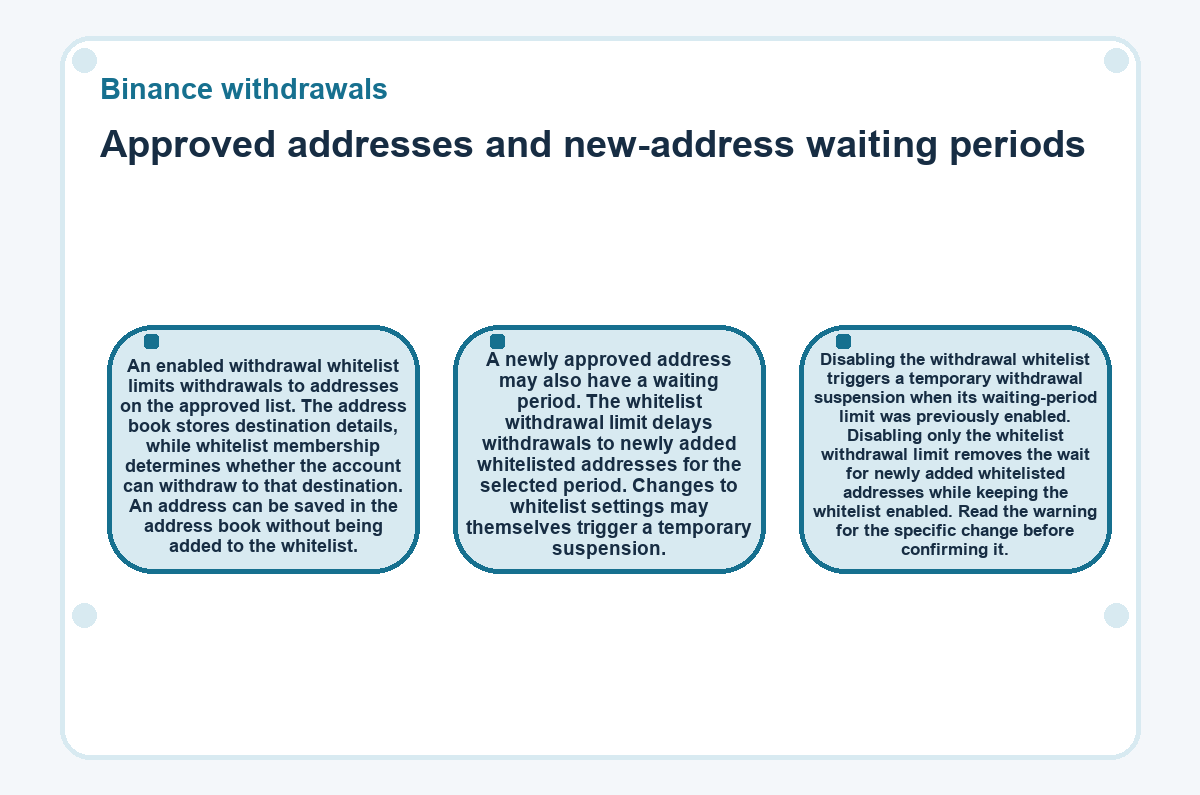
Approved addresses and new-address waiting periods
An enabled withdrawal whitelist limits withdrawals to addresses on the approved list. The address book stores destination details, while whitelist membership determines whether the account can withdraw to that destination. An address can be saved in the address book without being added to the whitelist. A newly approved address may also have a waiting period.
The whitelist withdrawal limit delays withdrawals to newly added whitelisted addresses for the selected period. Changes to whitelist settings may themselves trigger a temporary suspension. Disabling the withdrawal whitelist triggers a temporary withdrawal suspension when its waiting-period limit was previously enabled. Disabling only the whitelist withdrawal limit removes the wait for newly added whitelisted addresses while keeping the whitelist enabled. Read the warning for the specific change before confirming it.
Network suspension and compatible alternatives
A network-specific suspension can leave another supported withdrawal network available if the recipient accepts the same asset on that network. Wallet maintenance, network upgrades or congestion can interrupt the affected route. Account verification and an adequate balance do not restore a network that Binance has temporarily disabled. The withdrawal notice identifies the affected asset or network and may include an estimated reopening time. An estimate describes the expected restoration time; actual availability determines whether the route can process a withdrawal.
A different network changes the transfer's blockchain route and can change its minimum amount and fee. The recipient must support that route and the particular token on it. For a contract-based token, its contract address identifies it within the network; the receiving platform must accept that contract. Matching address formats alone does not establish compatibility. A memo or tag identifies the intended recipient account where a service shares a receiving address. Supply it when the destination requires it. A withdrawal reminder can notify you when the suspended route becomes available again.
Bank withdrawals and transfers within Binance
A fiat withdrawal follows the payment methods available for the account's currency and region, with each method's applicable limits and requirements. Bank transfers use bank-account details and payment processing rather than blockchain confirmations. Where a method requires matching account-holder names, the withdrawal must satisfy that requirement. The selected method shows its amount boundaries and fees. Bank processing can also affect when the payment arrives. A crypto withdrawal allowance does not establish the capacity or availability of a particular bank withdrawal method.
An internal transfer sends funds to another Binance account without a blockchain transaction. That option changes the recipient's exchange balance and keeps the funds within exchange custody. It does not create an external-wallet withdrawal.
Purchase-linked holds on particular funds
Some Binance P2P purchases carry withdrawal restrictions that depend on the payment market, verified location and purchase role. P2P means peer-to-peer trading between users. The T+1 rules apply to specified purchases and include an exemption for Binance P2P Merchants. Trading can remain available while withdrawal of the frozen amount remains restricted. Separate abnormal-activity controls can affect the wider withdrawal function. Binance automatically releases the amount held under T+1 when its waiting period expires; these holds cannot be lifted early. Other funds can have different withdrawal availability.
From a submitted request to credited funds
A submitted withdrawal can still await processing, so submission alone does not establish that an external transfer has completed. Exchange processing, blockchain confirmation and destination credit describe different states that can explain a delay.
Binance processing
A Processing entry indicates an unfinished request in Binance's withdrawal history. A security notice, an amount rejection and a processing entry describe different problems, so the status needs to be read alongside any account alert. A delay before dispatch belongs with Binance's withdrawal process.
Blockchain confirmation
For an on-chain withdrawal, Binance's Completed status means that Binance has sent the funds. The TxID is the blockchain transaction identifier that lets you inspect that transfer. A transaction can exist on the network while still awaiting confirmation. Check the confirmation count and whether the transaction succeeded. A confirmed transaction can still have failed; contact Binance Support if the on-chain withdrawal failed.
Receiving-platform credit
The receiving exchange or wallet applies its own confirmation and crediting requirements after dispatch. Network confirmation therefore does not always coincide with funds becoming available in a recipient's exchange account. If the transfer succeeded on-chain and has met the destination's confirmation requirement but remains uncredited, provide the TxID to that destination's support team. Until the receiving exchange credits and unlocks those funds, they cannot fund a further withdrawal from that account.
Binance withdrawals: common questions
-
Do I still need two-factor authentication after enabling one-step withdrawal?
- Binance may still require two-factor authentication when one-step withdrawal is enabled. The feature permits eligible small withdrawals to a whitelisted address without routine two-factor verification, subject to its selected quota. Enabling it does not guarantee that every later withdrawal will skip verification.
-
What happens if I omit a required memo or tag?
- A transfer without its required memo or tag may reach the receiving address without being credited to the intended account. Contact the receiving platform with the TxID and withdrawal details. Binance cannot recover a missing-memo withdrawal sent to an external platform, and destination-side recovery depends on that platform's process.
-
Can a credited crypto deposit remain unavailable for withdrawal?
- A crypto deposit can appear as credited while withdrawal access still awaits the required unlocking confirmations. Crediting and withdrawal unlocking can have different confirmation requirements for the selected asset and network. An incoming deposit that lacks sufficient confirmation may also affect withdrawals or transfers. Compare the deposit's confirmation count with its unlocking requirement to see whether that confirmation hold has cleared.
-
Does a withdrawal API response prove that the recipient received the funds?
- A successful withdrawal API response returns a request ID, which does not establish blockchain confirmation or recipient credit. The matching withdrawal-history record shows the request's later processing state and its TxID when an on-chain transaction exists. The request ID and blockchain transaction identifier describe different records, so receipt requires evidence from the destination.
-
Is every account withdrawal restriction eligible for an appeal?
- Some account restrictions are not open to appeal, particularly those involving law-enforcement orders or regulatory obligations. An absent appeal option does not establish that an ordinary security timer caused the restriction. The account notice can identify a different basis, and Binance Support can clarify the available process for that specific restriction.
-
Why am I getting an invalid withdrawal address message?
- An invalid-address message indicates a problem with the address entered for the withdrawal. Confirm the complete address and intended network with the recipient, then copy the address from its deposit instructions. A format that passes validation still does not establish that the recipient supports the selected asset and withdrawal network.
-
Would Binance Support require a transfer to a safe wallet to unlock withdrawals?
- Binance Support does not ask you to transfer funds into a separate wallet to secure your account. Someone who supplies a supposed safe-wallet address may control the receiving funds. Sending crypto there can cause another loss without resolving the account restriction. Discuss the hold through Binance's existing support flow and keep passwords and authentication codes private.
-
How does an internal transfer appear in withdrawal history?
- An internal Binance transfer has an internal transfer ID instead of a blockchain TxID. Its history record marks the TxID field as Internal, and the recipient's deposit history carries the same transfer ID. That shared ID identifies the transfer for support. A blockchain explorer will not show an on-chain transaction for that internal movement.